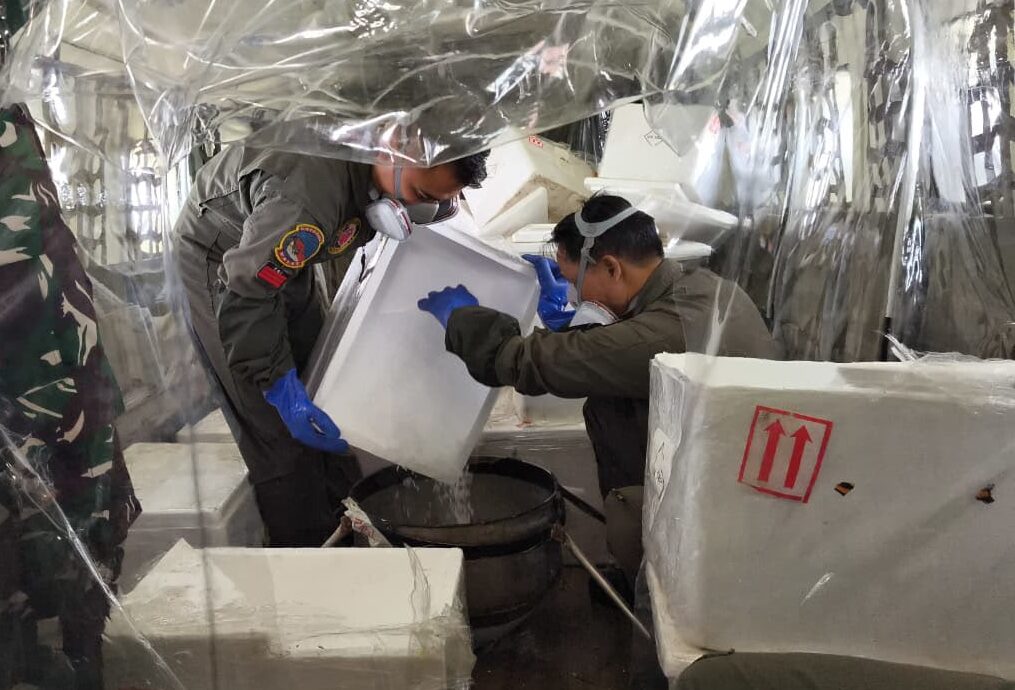
Jakarta (The Indonesian News) – The Indonesian government is testing the use of dry ice in weather modification operations in South Sumatra and Central Kalimantan to help reduce haze caused by forest and land fires.
Berton Panjaitan, acting head of the Data, Information and Disaster Communications Center at Indonesia’s National Disaster Management Agency (BNPB), said the innovation offers an alternative cloud-seeding technology to complement conventional methods using salt, or sodium chloride (NaCl).
According to Berton, the extremely low temperature of dry ice could trigger the formation of ice crystals in clouds, potentially supporting precipitation and rainfall.
“Dry ice is a solid substance with an extremely low temperature, potentially below minus 78 degrees Celsius. It is solid carbon dioxide. Its intense cold can rapidly trigger the formation of ice crystals in clouds, potentially leading to natural rainfall in an environmentally friendly way,” Berton said at a press conference on Tuesday, October 20.
During weather modification operations on October 19, 2026, BNPB reported several cloud-seeding missions across the two provinces.
In Central Kalimantan, authorities conducted five sorties using a combination of 1,600 kilograms of dry ice and 300 kilograms of salt.
In South Sumatra, three sorties were conducted. Two used a combined 1,600 kilograms of dry ice, while the third used 800 kilograms of salt
Berton said the use of dry ice was expected to produce observable effects relatively quickly, including improved visibility by helping alleviate atmospheric conditions affected by smoke.
“One advantage of dry ice is that its effects can be observed relatively quickly, including improvements in visibility. Dry ice can help initiate the formation of water droplets and ice crystals in clouds, potentially encouraging rainfall. This could allow weather modification operations to be carried out promptly when conditions permit,” he said.
However, Berton emphasized that weather modification operations remained dependent on atmospheric conditions and the availability of suitable clouds for seeding. As a result, operations cannot be conducted in every area at all times.
He cited Riau as an example of a successful operation. In Jambi, by contrast, cloud seeding could not proceed because suitable cloud formations were unavailable.
“The weather modification operation in Riau ended on September 25, 2026, because natural rainfall had already occurred there. In Jambi, we could not conduct cloud seeding or weather modification operations because cloud conditions were unsuitable and the feasibility of carrying out the operation was relatively low,” he said.
Source: Press release from the Government Communications Agency of the Republic of Indonesia (Bakom RI).