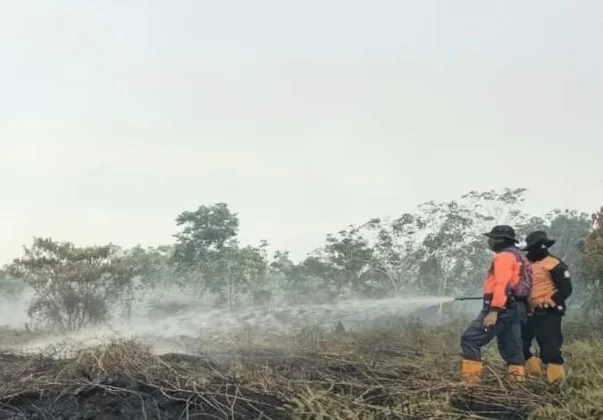
Jakarta (The Indonesian News) – Indonesia is continuing its efforts to contain forest and land fires, with the government shifting its operational focus to several affected areas in the eastern part of the country, the National Disaster Management Agency (BNPB) said.
Berton S.P. Panjaitan, acting head of BNPB’s Disaster Data, Information and Communication Center, said the government was prioritizing wildfire response in five provinces: South Papua, Central Sulawesi, Southeast Sulawesi, Maluku and East Kalimantan.
The shift marks a change from the previous focus on six provinces: Riau, Jambi, South Sumatra, West Kalimantan, Central Kalimantan and South Kalimantan.
“We can see that the pattern of forest and land fires across Indonesia has changed considerably,” Berton said at a news conference on Friday, October 30, 2026.
He said the government was now working to contain fires that had affected a total of 1,410 hectares across the five priority provinces.
South Papua recorded the largest affected area, at 502 hectares, followed by Central Sulawesi with 295 hectares, Southeast Sulawesi with 257 hectares, Maluku with 182 hectares and East Kalimantan with 174 hectares.
To accelerate firefighting operations, the government has deployed 58 aircraft and helicopters to support aerial suppression efforts and weather modification operations.
Of the total fleet, 39 aircraft and helicopters were provided by BNPB, 15 by the Indonesian National Armed Forces (TNI), and four through support from regional governments and private-sector companies.
Berton said the fleet had been reduced by one aircraft after a unit previously operating in East Java was withdrawn because the fire situation there had become relatively stable.
Nevertheless, all available aircraft remain on standby in case conditions on the ground change.
“If needed at any time, whether for weather modification operations or water bombing, we will deploy them immediately,” he said.
Alongside aerial water bombing, the government is intensifying weather modification operations by dispersing sodium chloride (NaCl) and dry ice to support wildfire suppression efforts.
On October 29, 2026, the government conducted 17 weather modification sorties, dispersing a total of 23,900 kilograms of dry ice and NaCl, Berton said. These operations, however, remained focused on three priority provinces: Central Kalimantan, South Kalimantan and South Sumatra.
He reported that the operations had helped trigger light to moderate rainfall in Central Kalimantan and South Kalimantan. In South Sumatra, rainfall ranged from very light to extreme intensity.
Berton emphasized that weather modification operations were continuing as part of the government’s broader response to forest and land fires in several regions.
“We hope this rainfall continues so that fire hotspots and smoldering fires beneath the surface can be fully extinguished,” he said.
Source: Press Release of the Government Communications Agency of the Republic of Indonesia (Bakom RI)