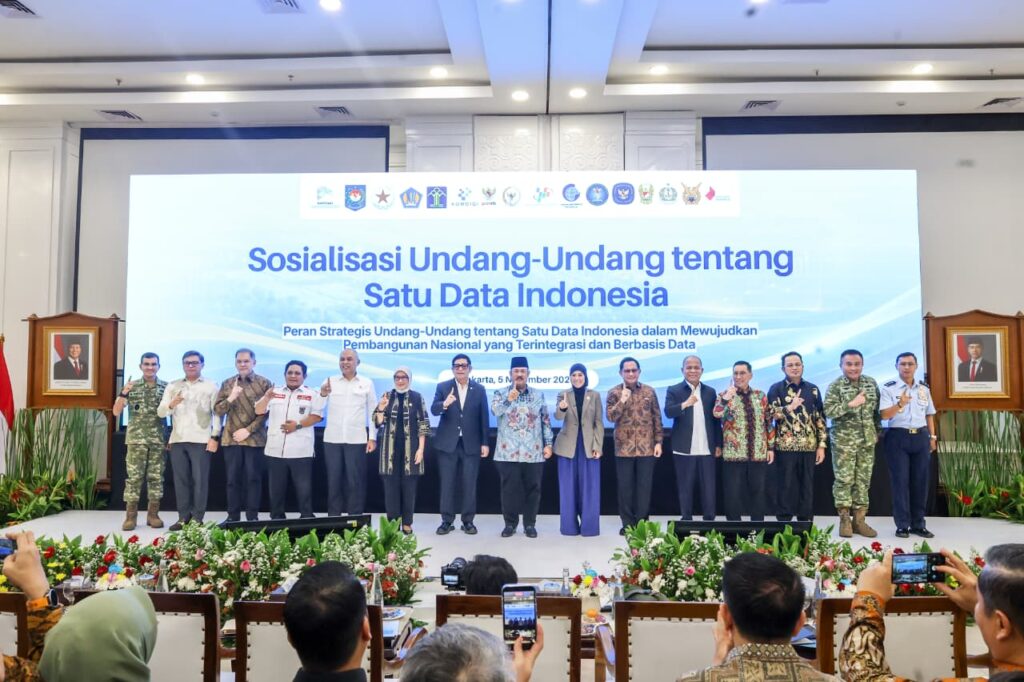
Jakarta (The Indonesian News) – Indonesia’s Ministry of National Development Planning (Bappenas) held a public briefing on the One Data Indonesia Law in Jakarta on Thursday, seeking to strengthen national data governance through an integrated, high-quality and secure data ecosystem to support development planning and more targeted public services.
Approved during a plenary session of the House of Representatives (DPR RI) on October 6, 2026, the One Data Indonesia Law (UU SDI) provides a legal foundation for aligning data management across government institutions and addressing fragmented information systems. It is intended to make reliable data a cornerstone of development planning, policymaking and improvements in public service delivery.
In his opening remarks, National Development Planning Minister and Bappenas Chief Rachmat Pambudy described data as one of the country’s most valuable strategic assets and the starting point for effective national development.
“Data does not belong solely to government systems. Data is a strategic national asset; data is the wealth of our future,” Rachmat said, Thursday, November 5, 2026.
Indonesia possesses vast amounts of data across sectors and regions, from Aceh to Papua, covering population, education, health, agriculture and natural resources. But to turn that information into a national asset, the minister said, it must be managed in a more integrated manner.
“Technology will continue to change, and systems will continue to evolve. But our goal remains to bring the state closer to the people, make it fairer and improve its ability to serve them. Only with accurate data can we do our best for the people,” he said.
Rachmat said data must be managed systematically, promptly and accurately so that it can serve as a reliable reference for development planning, fiscal policymaking, social assistance distribution and other government decisions.
Integration Without Centralizing All Government Data
Data integration does not mean that all government information must be stored in a single application or location. Ministries, agencies and regional governments will continue managing data within their respective mandates under a shared governance framework.
The alignment of data standards, metadata, reference codes, master data and interoperability mechanisms will enable information from different sources to be connected and used according to institutional needs and legal authority.
Maliki, acting deputy for economic affairs and digital transformation at Bappenas, stressed that centralizing all data was not the primary objective of the legislation.
“Centralization is not actually the main principle of the One Data Indonesia Law. The question is how data can be exchanged and used by other sectors while preserving the authority of each ministry and agency. That is why interoperability is one of the law’s core principles,” Maliki said.
He added that data exchange between government institutions must comply with established standards, clearly defined purposes and data security requirements.
Stronger Data Governance and Digital Sovereignty
The law introduces several strategic measures, including the establishment of National Basic Data as a primary reference for development policy, stronger institutional arrangements for One Data Indonesia, enhanced data security and sovereignty, simplified data-sharing mechanisms, and procedures for resolving disputes over data governance.
Stronger data governance is also considered essential to the responsible adoption of digital technologies, including artificial intelligence (AI). Such technologies require high-quality, reliable and accountable data to ensure their use is safe, responsible and beneficial to national development.
The new legislation builds on seven years of progress since Presidential Regulation No. 39 of 2019 established the initial One Data Indonesia framework. That work has included setting up institutional structures, strengthening the One Data Indonesia Forum, preparing action plans, developing the One Data Indonesia Portal, identifying priority data and evaluating implementation at both national and regional levels.
Better-Targeted Assistance and Public Services
For the public, better data integration is expected to translate into more effective policies and services.
In social protection, up-to-date and verifiable information can help the government identify eligible assistance recipients more accurately and reduce the risk of benefits being distributed to the wrong people.
Lawful and secure data exchange, conducted within the limits of each institution’s authority, is also expected to reduce the need for citizens to repeatedly submit the same information. This could make public services simpler, more efficient and more responsive.
In education, health care, agriculture, regional development and other essential services, reliable data can help authorities design interventions that reflect the actual needs of communities and local areas, while reducing overlapping programs and inefficient use of public resources.
The law also provides opportunities for public participation through feedback, community oversight and reporting suspected data misuse in accordance with applicable regulations.
However, greater data connectivity must go hand in hand with data security, personal data protection and access controls based on information classifications and institutional authority. These safeguards are intended to protect citizens’ rights and the country’s strategic interests.
Government and Parliament Back Implementation
The briefing was attended by Home Affairs Minister Muhammad Tito Karnavian; Minister of Communication and Digital Affairs Meutya Viada Hafid; Minister of Administrative and Bureaucratic Reform Rini Widyantini; and House of Representatives Legislative Body Chairman Bob Hasan. Leaders of government ministries and agencies, along with representatives of regional governments from across Indonesia, also joined online.
In his remarks, Bob Hasan said the law establishes National Basic Data as a mandatory reference for fiscal policy and social assistance distribution. To strengthen accountability, it also introduces graduated sanctions and provisions for public participation.
“The One Data Indonesia Law is not merely a law about technology and bureaucracy. It is a law about the rights of citizens,” Bob said.
The event continued with a panel discussion titled “The Policy Direction of the One Data Indonesia Law,” moderated by Dini Maghfirra, director of development data and digital government at Bappenas.
The panel featured Maliki; Yessi Arnaz Ferari, director of digital government applications at the Ministry of Communication and Digital Affairs; Teguh Setyabudi, director-general of population and civil registration at the Ministry of Home Affairs; Sulistyo, deputy for cybersecurity and government and human development cryptography at the National Cyber and Crypto Agency (BSSN); and academic Suhono Harso Supangkat.
Discussions focused on strengthening institutional arrangements and data integration, infrastructure and interoperability, the use of population data, and national data security and sovereignty.
Implementing the law will require sustained cooperation and shared commitment to prepare supporting regulations, strengthen the capacity of data administrators at both national and regional levels, and align government digital policies and systems within a common governance framework.
Bappenas emphasized that the success of One Data Indonesia should be measured not by the volume of information collected or the number of connected systems, but by more effective policymaking, better public services and a more equitable distribution of development benefits.
The initiative is intended to support inclusive, effective and evidence-based development as Indonesia works toward its Golden Indonesia 2045 vision.
Source: Ministry of National Development Planning (Bappenas)









 held a public briefing on the One Data Indonesia Law in Jakarta on Thursday)