Jakarta (The Indonesian News) – President Prabowo Subianto has often emphasized the importance of energy independence so that Indonesia can reduce its dependence on energy imports. This effort is increasingly important amid global uncertainty that can trigger price increases and disrupt energy supply.
One of these efforts began to be realized on July 1, 2026, when Indonesia implemented the B50 program. This real step was achieved three months before the completion of Prabowo’s second year in leadership.
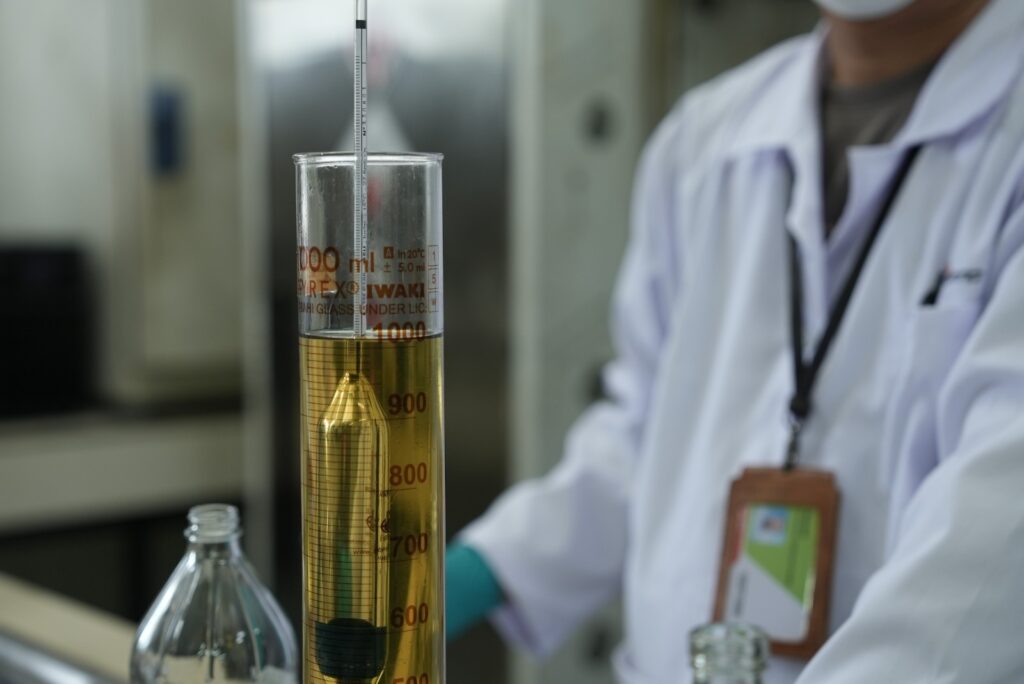
B50 is a fuel blend consisting of 50 percent biodiesel—a biofuel that can be made from, among other things, crude palm oil (CPO)—and 50 percent diesel fuel.
With this policy, Indonesia can further suppress diesel imports because part of the fuel needs can be met with biofuel.
At the launch of the B50 mandate in Karawang on July 9, Minister of Energy and Mineral Resources (ESDM) Bahlil Lahadalia said that this policy would make Indonesia no longer need to import diesel starting in 2026. On the contrary, Indonesia is projected to experience a diesel surplus of 4 million kiloliters (kL) starting this year.
“With the implementation of B50, we no longer import diesel; this is the first time,” Bahlil said, as quoted on Sunday (October 11).
B50 is a continuation of the B40 mandate implemented in early 2025. B40 is a fuel consisting of a blend of 40 percent biofuel and 60 percent diesel fuel.
Increasing the portion of biofuel in the biodiesel blend has the potential to provide a major impact on the economy.
Ministry of ESDM data shows that the implementation of B50 can help Indonesia save foreign exchange of Rp170 trillion this year. This figure is an increase of 27.5 percent compared to the foreign exchange savings of Rp133.33 trillion when B40 was implemented last year.
For Indonesia, these savings are not merely numbers on paper. Greater foreign exchange savings can strengthen Indonesia’s ability to maintain the stability of the rupiah exchange rate against the United States (US) dollar. In addition, these savings can help Indonesia face external economic challenges.
In addition to saving foreign exchange, the B50 policy is also expected to increase the added value of CPO to Rp23.49 trillion, up from Rp20.94 trillion when the B40 mandate was implemented.
This increase in added value has the potential to provide a chain effect on the economy at large.
First, the government has the potential to obtain additional tax revenue that can be reallocated to finance priority programs, such as social protection, equitable education, and expanded access to healthcare.
Second, this policy is estimated to increase labor absorption, which in turn has the potential to improve people’s income and welfare. The Ministry of ESDM recorded that the B50 program is projected to absorb 2.1 million workers and also support national economic growth.
Third, the increased absorption of CPO for B50 needs can reduce Indonesia’s dependence on raw CPO exports. Thus, the price of fresh fruit bunches (FFB) at the palm oil farmer level is expected to be better protected from sharp declines when global prices fluctuate.
“This can help provide market certainty for palm oil farmers,” he said.
Prabowo’s Real Action Toward Green Energy
In addition to providing economic benefits, the B50 mandate is also an important step by the government in encouraging the transition toward cleaner energy.
In this regard, B50 is expected to reduce Indonesia’s dependence on fossil energy. This program is projected to reduce greenhouse gas emissions by around 44.46 million tons of carbon dioxide in 2026.
B50 is one of Prabowo’s strategic steps to strengthen national energy resilience through a more environmentally friendly approach. This effort goes hand in hand with other strategic programs, such as the 100 gigawatt-peak (GWp) Solar Power Plant (PLTS) and the Waste-to-Energy Processing (PSEL) program.
Given the importance of B50 in realizing energy independence, Prabowo in August instructed the National Research and Innovation Agency (BRIN) to study the implications if Indonesia were to later adopt B60 through B100.
“I demanded that B40 energy independence is not enough. In fact, at that time, I pushed toward B100. But my ministers convinced me that with B50 alone, we no longer import diesel. So this is an extraordinary national achievement,” Prabowo said last July.
Source: Press Release of the Government Communication Agency (Bakom) of the Republic of Indonesia