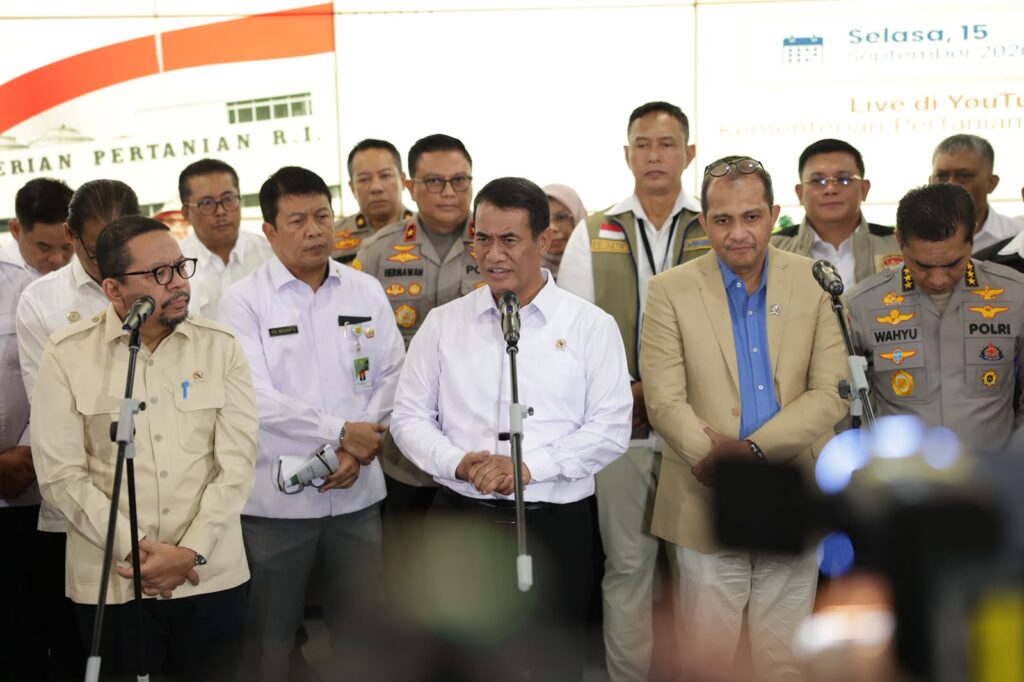
Jakarta (The Indonesian News) – The Indonesian National Police (Polri) is backing Agriculture Minister Andi Amran Sulaiman’s move to take firm action over findings that fortified rice products failed to meet food safety and quality standards. The support was voiced by Polri Inspector General of Supervision (Irwasum) Comr. Gen. Wahyu Widada in addressing the findings, which are seen as potentially harming the public.
“Polri is committed to delivering a fast, firm and measured response to any finding concerning rice that fails to meet food safety or quality standards,” Wahyu said at a briefing on the fortified rice investigation in Jakarta on Tuesday (15/9).
Wahyu said the alleged mismatch between the contents of fortified rice and the information on its packaging points to suspected criminal fraud. The suspicion emerged after the Ministry of Agriculture and the National Police Food Task Force conducted research and an in-depth review of products marketed as fortified rice.
“Based on the research and the matters examined in depth by the Agriculture Minister and the task force, there are indications of suspected criminal fraud,” Wahyu said.
He said the suspected offense could fall under Articles 492, 493 and 495 of the Criminal Code, as well as provisions of the Consumer Protection Law.
“The essence of those articles is selling something that does not match its contents,” he said.
According to Wahyu, the alleged violations could harm consumers in two ways at once: product quality and economic loss.
“This is certainly detrimental to consumers, both in terms of quality and potentially economically,” he said.
The economic harm is all the more serious because products claimed to be fortified rice were found being sold at prices far above what they should have been.
Wahyu stressed that the alleged violations are not being viewed as the acts of individuals alone. Police will also examine the possibility that parties acted in an organized manner or through a corporation.
“There is also a strong suspicion that this was not done by individuals alone, but possibly in an organized way and by a corporation,” he said.
He said the new Criminal Code provides for corporate criminal liability. The provisions cover penalties against corporations as well as additional penalties when an offense is committed by a business entity.
“There are indeed separate rules, as set out in Articles 120 and 121 of the Criminal Code,” Wahyu said.
Under those provisions, corporations may face fines and additional penalties in accordance with applicable rules. Additional penalties against corporations may include a range of measures, among them the revocation of certain permits as ordered by a court and under legal provisions.
Wahyu stressed, however, that the articles applied and the form of criminal liability will be determined by the outcome of the investigation and the evidence gathered. He deferred the process to law enforcement authorities, particularly the National Police Food Task Force, which involves units from National Police headquarters.
Wahyu assured that the law enforcement process will be carried out professionally, transparently and accountably, while prioritizing the protection of the public.
“The public must not be harmed. We will protect the public. And this is precisely the presence of Polri alongside the community,” he said.
The case began with the government’s discovery of 25 brands of fortified rice suspected of failing to meet the content and quality standards set out in SNI 9314:2024 for fortified rice kernels and SNI 9372:2025 for fortified rice. The products are alleged to have claimed on their labels that they contained certain vitamins or nutrients, while laboratory testing found a mismatch between the packaging information and the actual contents.
According to Minister Amran, the issue is a serious concern because fortified rice has the specific purpose of helping meet the nutritional needs of vulnerable groups.
The government estimates potential consumer losses from the alleged practices at around Rp89 trillion. The figure remains an estimate and is part of the ongoing inquiry by law enforcement authorities.
Amran has also ordered that the problematic products be withdrawn from circulation, their permits revoked, and those found to have committed violations prosecuted under the law.
“First, we ordered a recall; second, we revoked the permits; third, we are pursuing legal action,” Amran said.
Source: Ministry of Agriculture