Jakarta (The Indonesian News) – The adjustment to Pertamax prices that took effect on June 10, 2026, has again drawn public attention. This fuel price adjustment has raised various questions, particularly regarding the reasons behind the price change.
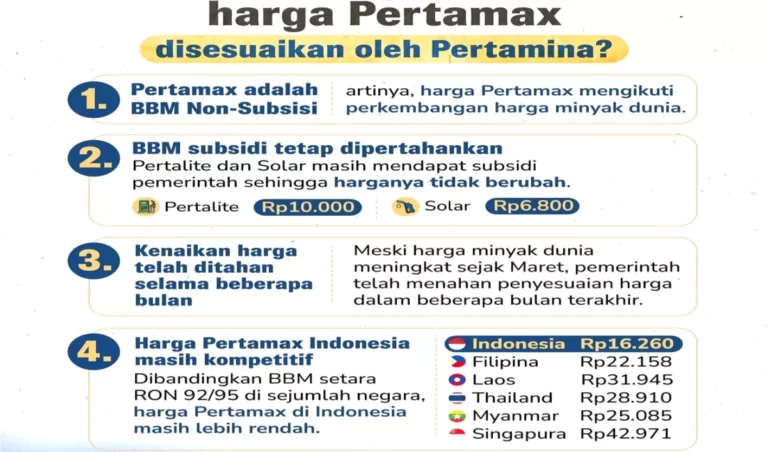
However, it is important to understand that Pertamax is a non-subsidized fuel, and its pricing mechanism differs from subsidized fuels such as Pertalite and Biosolar.
Quoted from the official Instagram account of the Cabinet Secretariat on Saturday (June 13, 2026), as a non-subsidized fuel, Pertamax’s price follows developments in global crude oil prices and international energy market conditions.
When global oil prices rise, non-subsidized fuel prices also have the potential to be adjusted to reflect the procurement and distribution costs that must be borne by the business entity.
In recent months, world oil prices have experienced a significant surge due to various global factors, ranging from geopolitical uncertainty to disruptions in international energy supply chains.
These conditions have impacted fuel production and procurement costs in various countries, including Indonesia.
Nevertheless, the government had held back non-subsidized fuel price increases for several previous months, so that the impact of rising world oil prices was not immediately felt by the public. The current adjustment is a response to continually changing energy market developments.
Meanwhile, users of subsidized fuel need not worry, as the prices of Pertalite and Biosolar remain unchanged. Currently, Pertalite remains at Rp10,000 per liter, while Biosolar remains at Rp6,800 per liter, in accordance with government regulations.
Price Adjustment Still Considers Public Purchasing Power
President Director of PT Pertamina (Persero), Simon Aloysius Mantiri, has emphasized that there is no change in subsidized fuel prices. According to him, Pertalite remains sold at Rp10,000 per liter and Biosolar at Rp6,800 per liter.
Simon explained that the price adjustment applies only to non-subsidized fuels, namely Pertamax and Pertamax Green, which took effect from June 10, 2026.
According to him, the policy was implemented taking into account global geopolitical dynamics and movements in international oil prices, while still considering public purchasing power.
“This adjustment to non-subsidized fuel prices was made by considering global geopolitical dynamics and applicable international oil prices, while still taking into account public purchasing power,” Simon said in his official statement.
He also emphasized that the price adjustment was not only carried out by Pertamina but also by several other private business entity gas stations selling non-subsidized fuel.
According to Simon, amid ongoing global challenges, Pertamina together with the government remains committed to maintaining energy availability for communities throughout Indonesia.
He invited the public to use energy wisely and to support efforts to maintain national energy resilience.
Still Cheaper Than Neighboring Countries
Despite the increase, Pertamax prices in Indonesia are still relatively competitive compared to fuels with equivalent RON 92–95 specifications in several Southeast Asian countries.
Based on data as of June 11, 2026, the price of Pertamax in Indonesia stood at Rp16,250 per liter.
This figure is still lower than the Philippines, which reached Rp22,158 per liter; Myanmar at Rp25,085 per liter; Thailand at Rp28,910 per liter; Laos at Rp31,945 per liter; and Singapore, which reached Rp42,971 per liter. This price data is sourced from Petrol Price, GasWatch, and Global Petrol Prices.
This price comparison shows that although a price adjustment has occurred, the Indonesian public still obtains non-subsidized fuel at relatively more affordable prices compared to several neighboring countries.